The fossil fuel industry has mounted a massive campaign to portray renewable energy as an unrealistic, unaffordable fantasy promoted by woke elites. It has the support of the US Government: the President recently re-stated his claim that climate change is a hoax, and in Munich in February the Secretary of State, Marco Rubio, said that European economic policies were driven by a “climate cult” that was impoverishing western society.
Nothing could be further from the truth. But to understand the falsity of this argument, we must look outwards, not inwards. In a previous post I described how the extraordinary growth in availability of cheap photovoltaic (PV) panels (solar cells) has transformed access to affordable electricity in developing nations. Data from Yale University (below) show that in the course of the last 15 years, solar power has gone from being the most expensive source of energy to the cheapest, closely followed by wind power. Pakistan, a nation almost as populous as the United States, is able to generate nearly all the electricity it needs from solar power, and Reuters reported recently that Lahore, a city of 15 million, is soon expected to produce more than 100% of the electricity it needs from solar energy. Through this quiet, peaceful revolution, Pakistan has freed itself from dependence on foreign fossil fuel, and from the colossal economic burden that accompanies this dependence.
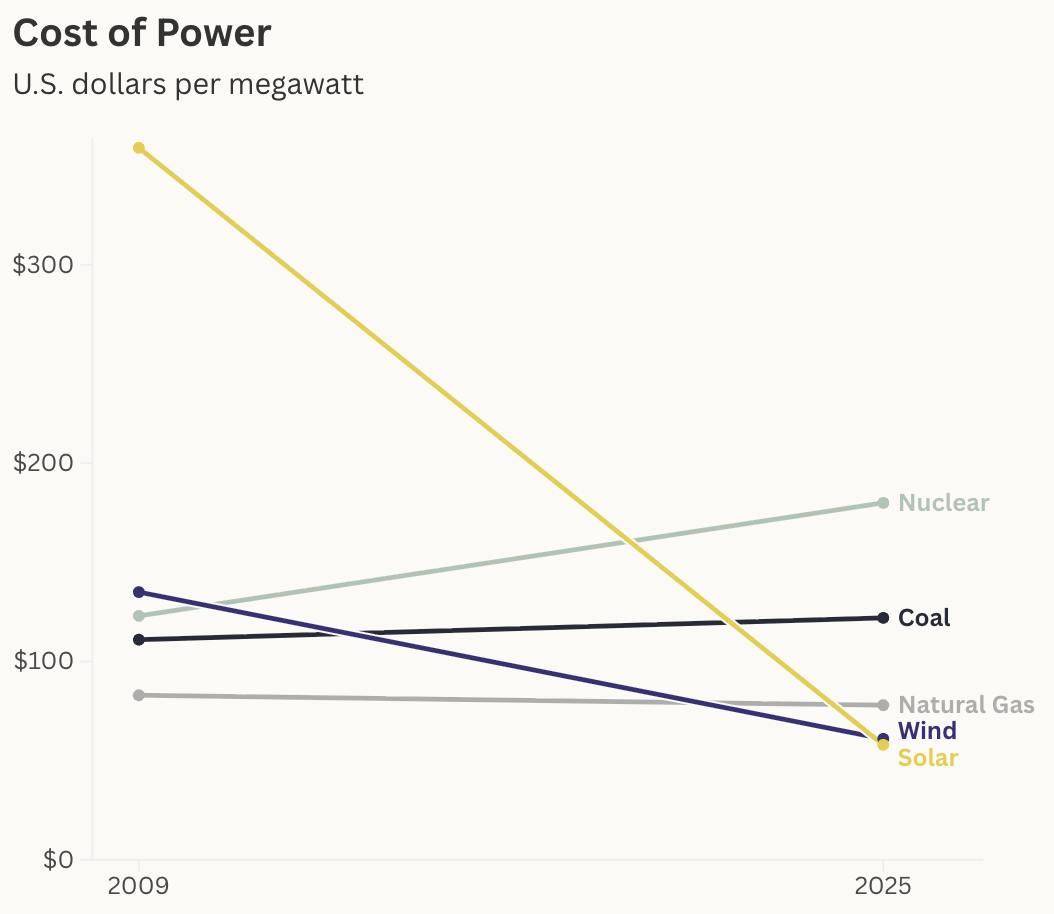
Figure 1. The cost of building, maintaining, and fueling a new power plant, without subsidies, adjusted for inflation. Prices based on combined cycle natural gas, utility-scale solar, and onshore wind. Source: Lazard. YALE ENVIRONMENT 360
Ethiopia provides a further striking illustration of the impact of electrification far from western “woke” elites. In November, the Guardian reported that Ethiopia had banned the import of new petrol and diesel cars. Until recently, electric vehicles (EV) were almost unheard of in Ethiopia; now, however, EV are a growing fraction of the cars on Ethiopia’s roads. And the reason? It’s economics, not ideology. Bloomburg reported that “Ethiopia imports all the oil it consumes, with the bill reaching $4 billion in 2022. It defaulted on its sovereign bonds in 2023 and got a $3.4 billion bailout from the International Monetary Fund”. Of course the EV are imports, but Ethiopia doesn’t have a car manufacturing industry, so importing EV rather than petrol engined vehicles, frees the nation from an on-going commitment to pay for fossil fuel imports in the future. The completion of a massive dam that will double Ethiopia’s electricity generating capacity is an integral part of a strategy that is aimed at creating greater energy self-sufficiency through the exploitation of green technology.
It is clear that the developing world increasingly realises that enslavement to fossil fuels is both unaffordable and unnecessary; fossil fuel addiction is in fact a luxury that only elites can sustain. China’s green manufacturing boom is upending economic doctrines, shattering the link between fossil fuel resources and economic power that dominated much of the last 100 years. The cultists are not those who are embracing cheap, green technology that can save us from the worst excesses of climate change, but those who worship at the hydrocarbon shrine and promise to sacrifice our futures for the wealth of fossil fuel producers.

Figure 2. Data for sales of new vehicles in Ethiopia. Electric vehicles have almost completely displaced internal combustion engines. From Bloomberg.
 Science and Non-Science