The Institute of Economic Affairs is a right-wing think tank (for this piece, the IEA, but elsewhere in my blog, not to be confused with the International Energy Agency, also the IEA, which does really important work). Under new leadership from Lord Frost, Boris Johnson’s Minister for Brexit, the IEA is following in the tracks of the Heartland Institute by spreading misinformation.
In a recent video on YouTube the IEA launched what it called its “landmark new report ‘Just Stop Oil?’”, drafted by “energy analyst” Kathryn Porter. Porter has a consultancy, Watt Logic, but she now writes regularly about energy for the Daily Telegraph. We’ll come to the report shortly, but first the video.
“If we tried to stop oil we’d be ending modern life”
The title of the IEA’s video – “Just stop oil” – references the eponymous campaigning group. In what the producers probably feel is a clever trick, they begin by explaining that oil is in fact important for producing a variety of chemicals that are important in modern life, including pharmaceuticals. Our lives would be unrecognisable, Porter argues, without oil. “If we tried to stop oil”, she says, “we’d effectively be ending modern life”.
Of course, as a professional chemist I am well aware of the connection between petroleum and pharmaceuticals – which of course is one of the reasons one might argue that petroleum is too valuable for us to allow it to be burned in such a careless way. However, I also know that all of those same organic chemicals can be made from coal (which before the emergence of abundant cheap petroleum 70 years ago was used to produce synthesis gas and hence, organic chemicals) and many other carbonaceous materials; and in the future they may very well be produced out of thin air, because eventually we will need to reduce atmospheric carbon dioxide levels and technologies are now being developed that can capture atmospheric CO2 and turn it into organic chemicals using sunlight. It is, after all, what Nature has been doing for nearly four billion years. Such technologies cannot sequester carbon at the rate at which it is being discharged into the atmosphere, but there is a good probability that in time such technologies will meet our need for organic chemicals.
The point that Porter thought she was very cleverly making is that anybody who backs a campaign to Just Stop Oil is effectively campaigning to abolish modern life as we know it, including modern medicine. However, if I asked Just Stop Oil to respond, I’m sure they’d say “that’s really not the point; we’re campaigning is to prevent climate change caused by burning fossil fuels”. Scientific evidence suggests very strongly that such climate change will entail many harms for humanity, including death on a large scale. The former chief scientific advisor to the UK government, Prof Sir David King FRS has warned that “on our current path, civilisation as we know it will disappear”. Porter would no doubt accuse Sir David of “climate alarmism”, but she has served up in riposte a different and opposing alarmism: “If we tried to stop oil we’d effectively be ending modern life”.
“Modern agriculture completely depends on methane” says Porter, “methane is the core ingredient for fertiliser”. Ammonia is the key precursor from which ammonium nitrate fertiliser is manufactured; it is produced from hydrogen and nitrogen using the Haber-Bosch process. In conventional ammonia manufacturing, it is true that the hydrogen used to manufacture ammonia is produced by steam reforming of methane (which is the main industrial route to hydrogen production). But this is by no means the only way to obtain hydrogen: electrolysis of water is an obvious alternative that becomes feasible once there is sufficiently abundant renewable energy. Once green hydrogen is available, it is straightforward to manufacture ammonia using nitrogen from the air in a carbon-free process, and an ammonia plant can be built anywhere – it does not need to be constructed at the end of a large gas pipeline. Ammonia manufactured using green processes has also attracted growing interest as a means for energy storage: ammonia is hydrogen rich but unlike hydrogen, it can be easily liquified (at -33oC rather than -253oC) and transported, and has a comparatively high energy density; recently the UK research councils have funded a variety of projects aimed at providing innovative, carbon-free alternatives to the production of ammonia. These include a project at Cambridge that aims to “deliver an agile (fast response), efficient (high energy storage), distributed (low capital versus the economy of scale of the conventional Haber Bosch process) ammonia synthesis process aligned to the intermittent and geographically isolated production of renewable energy.”
“The climate cult”
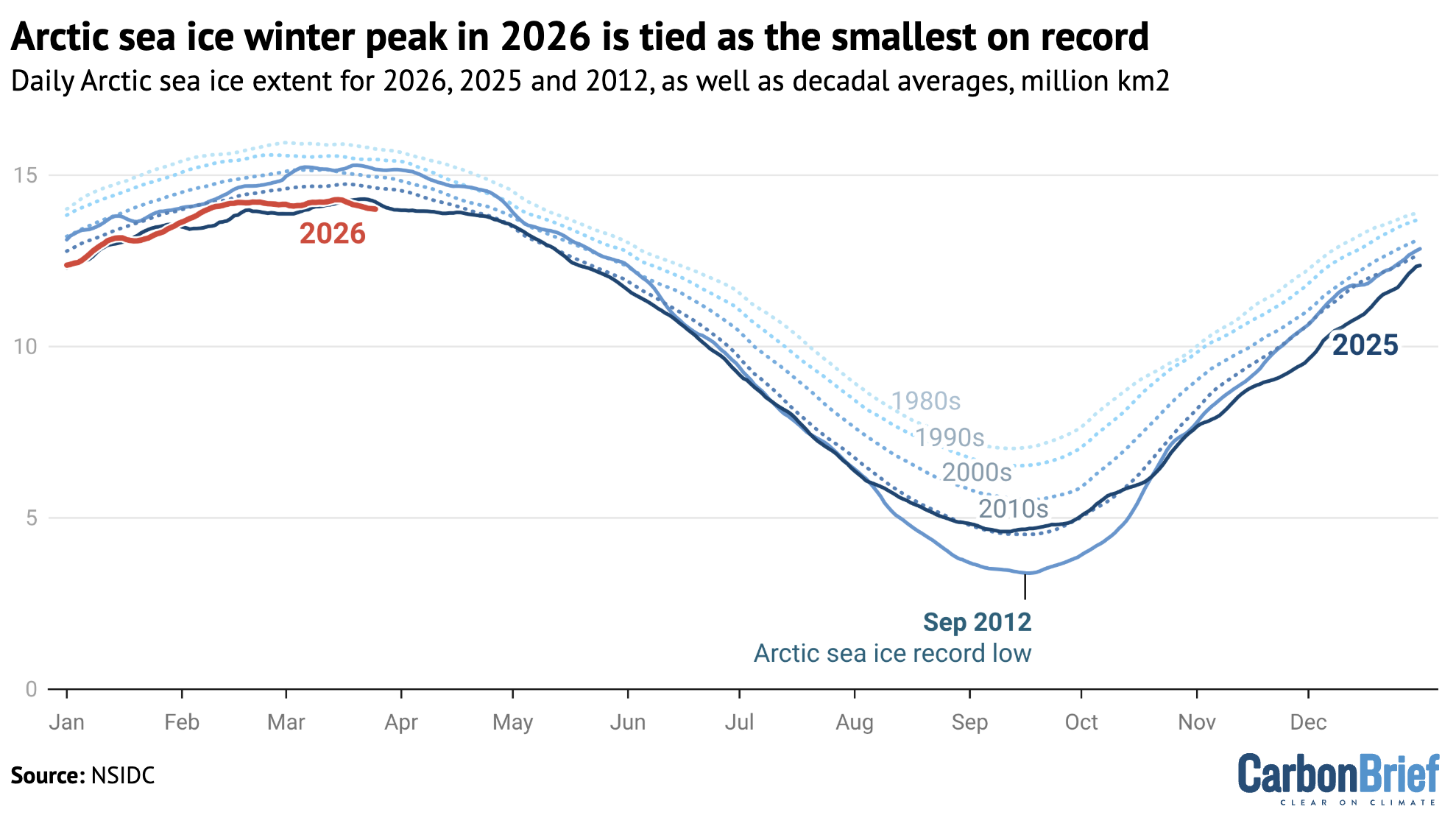
A quarter of the way through the IEA film Lord Frost asserts that not only are “people” no longer concerned about rising CO2 concentrations, but in fact “people” are now no longer believing in the possibility of apocalyptic consequences resulting from climate change. He presumably excludes from the term “people” the thousands of climate scientists all warning of impending climate breakdown. Porter responds “well there is certainly no evidence of near-term apocalyptic consequences…twenty years ago people were telling us London would be under water by now and that the Arctic would be ice free in the summer – things that just haven’t come about”. This is a classic deployment of the straw man argument: present an outrageous claim that your opponent never made, and then demolish it and claim your opponent to be vanquished. I have followed the science of climate change for over three decades and I cannot remember any scientific modelling that suggested London would be under water by 2026. On the other hand, it is undeniably the case that the amount of Arctic Ice has reduced alarmingly (for example, see recent data reported by Carbon Brief). There is hard evidence (see below) that the predictions of climate models are unfolding in real time.
Andy Mayer, the CEO of the IEA adds that “the number of people harmed by climatic events has been falling over the last 100 years”. This is a meaningless claim that the Heartland Institute has also made to try to demonstrate that nothing bad is happening as a consequence of climate change. 100 years ago, there were no satellites, so of course people didn’t see hurricanes coming. But the point here is not, in any case, that the entire threat posed by climate change can be crystallised into a small set of acute extreme weather events; what concerns us is, for example, the chronic degradation of agricultural land, whether by drought or by increased flooding, that will make life increasingly hard for the worlds poorest people and eventually for its wealthier denizens too. In the green county of Yorkshire, agricultural yields were down by 20% last year after a long dry summer, and farmers are beginning to wonder about the viability of their businesses in a warming world. That is an indicator of what lies ahead.
Having dismissed climate science, Porter criticises Ed Miliband for having views that are “religious not scientific” and Mayer complains about workers in the oil industry in Aberdeen being “sacrificed on the altar of this new religion”. The same kind of language was deployed by the US Secretary of State recently, referring to the “climate cult” at Davos. Ironically, as the representative of a government propelled to power by religious fundamentalism, he was trying to project religious extremism as irrationality. However, these people are rejecting peer-reviewed scientific knowledge produced by an objective process of conjecture and refutation, and accusing anybody who takes it seriously of being the member of a religious cult. I am not attacking religion here – far from it; the use of “religion” by the IEA carries with it negative connotations to from which I would demur. However, what is profoundly troubling here is the eschewal of rational argument, and a resort to name-calling and ranting, in the face of a vast body of knowledge produced by a rational, objective process that must either be corroborated or falsified.
The cost of gas
Porter appears to believe that the fossil fuel reserves in the North Sea are more or less limitless. Nothing that she says gives a realistic representation of either the amount of resource in the North Sea, or the challenges of extracting this declining resource – the nearer the bottom of the barrel you are, the harder it is to extract its contents and the higher the cost. For example, the price of oil needs to be at least $40 a barrel for Equinor just to cover the extraction costs in Rosebank. Indeed she states explicitly that the problems have nothing to do with geology, when plainly they do. She is particularly concerned to attack the argument that renewables are cheaper than gas. She wants to attribute this in part to the carbon levy but she also wants to project the idea that concerns about the cost of fossil fuels are not grounded in reality. “Prior to 2021 we heard no talk about the price of gas” she says, meaning that arguments about the price of gas are a new rhetorical device. But that’s a misrepresentation of the situation.
Porter says correctly that gas prices started to rise after Covid, and that shortly after this there was a further price shock due to the loss of Russian gas after the invasion of Ukraine, but “by the end of last year that had been dealt with…enough LNG [liquified natural gas] had come into the market to do that…and if you look at the forward curve, its very strongly downward sloping“. The US is the largest producer of LNG, but the US Energy Information Administration forecasts no such decline in the price of natural gas. Once the spike in prices following the invasion of Ukraine had passed, the trend in US natural gas prices has been steadily upwards (the spike in January this year is due to the cold snap in the US in that month with placed pressure on supplies). In a recent research paper published by the House of Commons Library, data were presented that portrayed a broadly similar picture, and described neither falling prices in the recent past nor a projected decline in the near future. One of the reasons for this is the fact that North Sea gas reserves are declining, and the alternatives (local shale gas production and LNG imports) are significantly more expensive (UK wholesale gas prices remain 28% below those in the EU because of the continued availability of North Sea gas).
The broader, more fundamental question that Porter does not address is that with North Sea Gas declining what is the best way to make UK energy secure? Imports or renewables?
The ‘Landmark Report’
The report falls into two halves. The first 50 pages make the case that it is unfeasible, economically damaging and unnecessary to transition away from fossil fuels, and the second half consists of a lengthy diatribe against the windfall tax on oil and gas combined with a set of case studies making the argument that UK oil and gas producers are being harmed with consequent impact on the UK. The latter set of arguments is not my main focus here, but it is important to make a succinct rebuttal.
- The 78% windfall tax was introduced when gas prices soared following the invasion of Ukraine. Gas and oil prices are determined not only by the cost of extraction but by the international market; there are times when the price is many times larger than the cost of extraction. Compared to historical values of ~$30 per barrel, current prices for Brent crude (over three times that) reflect the international market, and not a change in production costs. Of course, because the North Sea is a mature resource, production costs are increasing, and this becomes an economic challenge for new field such as Rosebank, where a price of $40 per barrel is needed just to cover extraction costs. However, removing the windfall tax would not change the basic equation: once the viability of a resource is dependent on the long-term persistence of historically high oil prices, there is a problem.
- Norway – about which Porter speaks in approving terms – levies a tax of 78% on oil profits. In contrast to the UK, which handed its resources to private companies, Norway has consistently used taxation to generate wealth for the Norwegian people from its fossil fuel resources. Nobody is suggesting that Norway’s activities in the North Sea are on the verge of collapse as a result. And why should Norwegian producer Equinor pay less tax to drill in British waters than it does in Norwegian waters? Meanwhile Norway has accumulated a £1 trillion sovereign wealth fund from levies on the profits of North Sea prospecting.
- Porter carries out detailed analyses of the economic challenges facing smaller UK producers of oil and gas. This is a valid form of advocacy. However, the general thrust of her argument – that support for these producers is in the national interests, that it provides energy security and that it is a better bet than transitioning to renewables – takes her from legitimate advocacy to careless propagandism.
Doomism
Porter attempts to lay the foundation for these claims in the first half of her report, and she begins by arguing that the transition to net zero is not feasible, and not supported by our international competitors. The US climatologist Michael Mann warns of what he calls “doomism” in his excellent paleoclimatological analysis of the Earth’s changing climate, “Our Fragile Moment”. Once upon a time, he argues, climate change deniers were the principal obstacle to action on climate change; however, the argument has shifted and we are now confronting “well, yes, its happening, but there’s nothing we can do about it”. This new approach is very dangerous, argues Mann, because despair drives inaction even among concerned citizens – and because emerging technologies may at last allow us to tackle the problems that threaten our children’s futures. Porter blends both of these approaches: in the IEA’s video, she derides predictions of climate breakdown by thousands of climate scientists; and in the first half of the “landmark report” she argues that it is in any case unlikely that the UK or any other nations will each net zero and that we are still going to need gas and oil in 2050.
This approach is widely promoted by fossil fuel interests, and when the US Energy Secretary established his Climate Working Group in 2025 to release a fossil fuel-friendly climate assessment, he selected 5 individuals (compared to the 721 working on the Intergovernmental Panel on Climate Change, IPCC) known to take the contrarian view that there isn’t much we can do about climate change and that if we tried, we would bankrupt ourselves. These five included an economist, the former director of research at BP, and three septuagenarian retirees who had previously worked in climate science but who believed that decarbonising the economy would be impossible and very costly. The journal Science quotes Naomi Oreskes, a historian of science at Harvard University: “This shows how far we have sunk. Climate denial is now the official policy of the U.S. government.” Porter is very much on the same page as these folks, despite fast-growing evidence that the truth is very different.
The thing about doomism is that it desensitises people. “What’s the point in going green”, they begin to feel, “if there’s nothing we can do about climate change anyway?” For the fossil fuel companies, like the tobacco companies and crack dealers, what matters above all else is to continue selling their product, whatever the cost to their customers. Anything that undermines the desire to break the addiction is a good thing as far as they are concerned, and the Institute for Economic Affairs stands ready to help.
Misinformation
Porter’s argument runs as follows: stopping oil will mean the end of modern civilisation (pp 12-14); we can’t do it anyway – we’ll still be burning oil and gas in 2050 (pp 15-17); we’re exporting our emissions to other countries (pp 18-22); renewables are too unreliable to replace fossil fuels and most energy is produced by burning things (pp 22-29); renewables are more expensive than fossil fuels (pp 30-46).
Porter includes some numerical data but they are at best two years out of date. The last few years have seen a massive acceleration in the utilisation of renewable energy; given this high rate of change in the use of renewable energy technology, Porter’s report presents a highly misleading picture of what is now happening globally. For example, it is true that for most of the last 60 years there has been a steady increase in global energy consumption, and that the vast majority of this has been through increased fossil fuel use (Figure 6). However, Porter’s graph stops at 2024. Data released recently by the International Energy Agency show that global fossil fuel use in 2025 was little different from consumption in 2024 (in other words growth in the use of fossil fuels is slowing markedly); in contrast, the contribution of renewables to global energy increased dramatically, to 101 exajoules (EJ) from a global total of slightly more than 600 EJ. Slightly more than 50% of global energy growth came from renewables in 2025. Half of this growth was from solar energy. Thus the picture is changing fast.
Opponents of the green transition have long regarded China as the ace in their hand. The arguments are many: applying a carbon levy on UK energy drives jobs to China, where there are no green levies; what does it matter what we do in the UK when China is pouring carbon dioxide into the atmosphere? etc. Porter trots out the familiar arguments and supports them with carefully selected out-of-date data. Her Figure 8 depicts the popular picture of China’s energy mix: tiny amounts of renewables, with the majority being coal and gas. Porter says (p. 32):
“We can see in Figure 8, that China’s use of fossil fuels has grown much faster than its use of wind and solar, and while fossil fuels make up a declining portion of China’s overall energy use, their growth in absolute terms, driven by a huge increase in primary energy consumption, dwarfs the growth in renewables.”
Porter says that while the UK has been one of the world’s largest investors in wind energy (Fig 14, p. 44), its electricity costs remain high “compared with countries such as the US and China, which have much lower amounts of intermittent generation in their energy mixes.” China needs cheap energy to support manufacturing, she argues; if China chooses coal it is because that’s the cheapest way to produce energy.
However, the picture in China has changed dramatically in recent years. The International Energy Agency’s 2026 Global Energy Review paints a rather different picture from Porter’s:
“Coal demand was flat in China: strong renewables growth pushed down coal use in electricity generation, while in industry, lower coal use in steel and cement production was offset by increased use for chemicals. Coal demand for power generation decreased in India, mostly due to an early, strong and long monsoon…Emissions from China fell due to the boom in renewables, structural declines in energy-intensive industry, and overall slower demand growth. India’s energy-related CO2 emissions were flat for the first time since the 1970s, largely due to cyclical effects from a strong monsoon combined with structural growth in renewables.”
Together, China and India represent a third of the Earth’s population. It is hard to overestimate the significance of this change. It provides hope for the future: a new model for generating the energy to sustain economic growth. Porter is right: China needs cheap energy (increasingly electrical energy) but she is entirely wrong about what we learn from the Chinese example: China is increasingly meeting its needs through renewables. The US has a very different energy mix, and the largest growth was in coal power; but this, not is the truly ideological pathway, because coal and gas are now more expensive than wind and solar. The contrast between the choices of China and the US is profound and the impacts of these choices will be long-lasting.
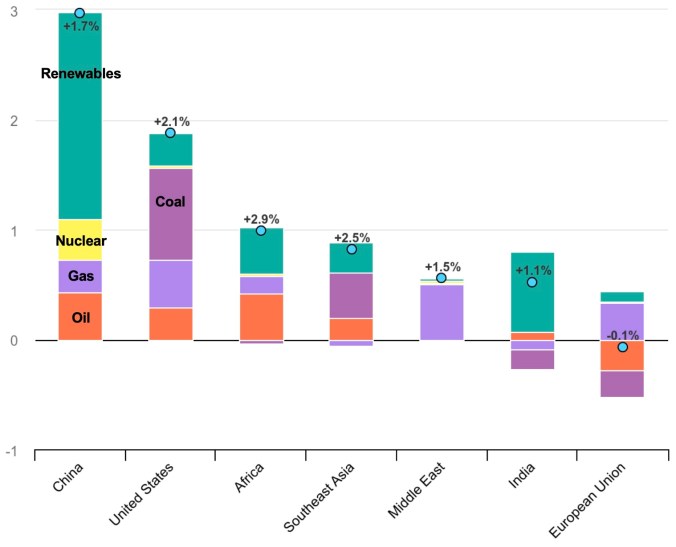
Data source: IEA (2026), Change in energy demand in selected regions, 2025, IEA, Paris https://www.iea.org/data-and-statistics/charts/change-in-energy-demand-in-selected-regions-2025, Licence: CC BY 4.0
The Age of Electricity
While industrial consumption of fossil fuels continues to be important, there have been important changes in many other technologies, including transportation, and the relative importance of electricity in the global energy mix is rising. Electricity production is comparatively easily decarbonised, so this is an important trend. The International Energy Agency reports that
“in 2025 demand for electricity grew at well over twice the rate of energy demand, reaffirming that the world has entered the Age of Electricity. Electricity demand growth was again driven by a wide range of end uses in buildings and industry. Although only contributing a small share of this total growth, demand from electric vehicles and data centres grew rapidly. In the United States, data centres made up half of all growth in electricity use.
“Growth in solar PV met more than one-quarter of global primary energy demand growth, the first time on record that a modern renewable source contributed the largest share of the growth in global energy demand…Coal demand growth slowed, due to declines in China and India. In all, low-emissions sources contributed nearly 60% of total energy demand growth.”
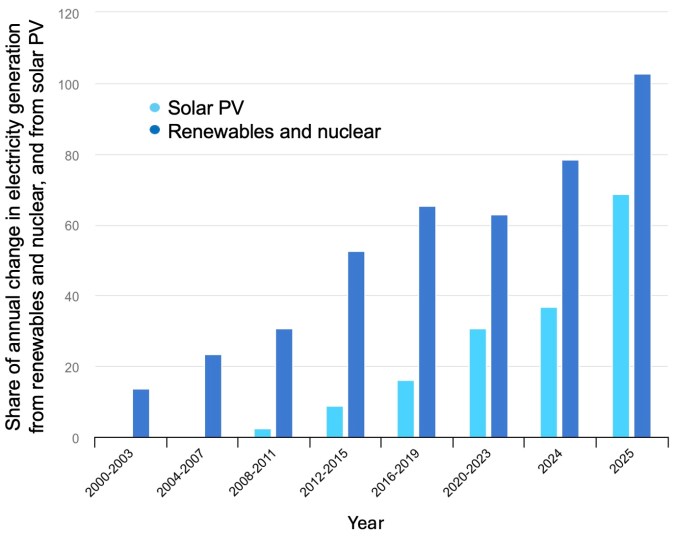
Data source: IEA (2026), Share of annual change in electricity generation from renewables and nuclear, and from solar PV, IEA, Paris https://www.iea.org/data-and-statistics/charts/share-of-annual-change-in-electricity-generation-from-renewables-and-nuclear-and-from-solar-pv, Licence: CC BY 4.0
For somebody who styles herself as an energy consultant, Porter seems to be remarkably ignorant of one of the most important recent trends in energy technology: the rapid advances in battery technology. In the 115 pages of her “landmark report”, the word “batteries” appears just three times (“battery” doesn’t appear once), on pp 25 and 26 in relation to an experimental solar project by Greenpeace in 2014 intended to provide power to people in an Indian village with no access to electricity, and on p. 29 in comparison with pumped storage.
Porter wants us to believe that it is impossible to build a modern society around renewables because of the intermittency associated with wind and solar. However, a failure to consider batteries in a report replete with such complaints is unjustifiable. Battery technology has expanded at tremendous speed in recent years and provides a major part of the solution to this problem. California – a state synonymous with technology – has been world leading in transitioning to green electricity. It has invested massively in large-scale battery storage, so that Califronians can use solar energy at night. Recent data released by Stanford engineering professor Mark Z Jacobson show that during daytime on May 16th, California met more than 100% of its electricity needs from renewables for a period of over 10 h, largely from solar PV. Excess energy was stored in the battery facilities that the state has been investing in, enabling solar energy to continue providing electricity after the sun had set.
But what about the cost? Bloomberg reports that “the global benchmark cost for a four-hour battery project fell 27% year-on-year to $78 per megawatt-hour (MWh) in 2025 – a record low since BNEF began tracking costs in 2009”. Battery storage is now cheaper than coal and gas, although still more expensive than solar PV and onshore wind. Iron-air batteries are being developed for grid-scale storage, while there is increasing work on the development of sodium batteries. Such developments promise to resolve any concerns about the scarcity of lithium.
Battery technology is going to be increasingly important in the future. Domestic battery storage is expanding in the UK as more people invest in solar PV, but even for people without solar PV, batteries are an increasingly cost-effective way of accessing cheap energy. In the UK, we benefit from high levels of wind energy around the clock. That means that there is often a glut of energy at night – hence consumers with smart meters are able to access cheap energy. In the IEA’s video, Porter sniggers at the idea of offering cheap off-peak electricity: “are people expected to do their laundry at night?” she asks. But many do this already – my washing machine has a timer and can can wash my clothes while I sleep, and my electric vehicle charges using cheap electricity at night. However, widespread take-up of home batteries, and the integration of electric vehicle batteries into the national grid as a form of distributed storage of energy, offer enormous potential to balance temporal
A Balanced View
An energy policy that placed our long-term hopes on a diminishing resource in the North Sea and on ignorance about powerful new renewables technologies would lead the UK into a worse place and not a better one. However, it is undeniably the case that we are in a period of transition: while the levelised cost of producing electricity from renewables is less than that of producing electricity from fossil fuels, the UK national grid requires extensive improvements to facilitate the growth in consumption of electricity that will accompany the transition to energy use based more on green electricity and less on burning fossil fuels. In the meantime, we will indeed continue to burn gas to heat our homes and to generate electricity. Currently the UK benefits from lower gas prices than much of Europe because of the availability of North Sea Gas; when that runs out, we will have to rely on imported LNG if we do not transition away from fossil fuels, which is not only more expensive but also more environmentally damaging, because of the substantial impact of methane losses during the extraction and transportation of LNG.
Thus while the “green transition” need not bankrupt the UK, these additional costs need to be borne in the short term, and they must be acknowledged by politicians. Likewise, the threat posed by declining resources in the North Sea needs to be recognised, and the limited nature and high extraction costs of UK shale gas also need to be acknowledged. Perhaps the most awkward political challenge entailed by addressing the problem of climate change is the acknowledgement that it will not be possible to save ourselves from the impact of climate change without making some changes to the way we live. We cannot deal with gratuitous consumption of fossil fuels, whether in aviation or space heaters or enormous SUVs, by planting a few trees; we cannot simply flip a green switch and carry on as we were. However, the explosion of cheap solar power provides hope for the future for our planet and impetus to continue the pursuit of Net Zero.
In the meantime, the high cost of electricity is a challenge both for its citizens and for its energy-intensive industrial base. There are multitudinous reasons for this. They include global political instabilities, the rising cost of imported LNG, the requirement for greater surplus capacity for renewable electricity generation because of variations in supply, and the complicated electricity market in the UK which links the cost of electricity to the cost of gas even when the electricity is produced renewably. There is some capacity to compensate for these factors via the taxation system; the Government recently made the decision to remove the renewables levy away from electricity prices earlier this year, as a move to reduce domestic energy bills and one could additionally argue that there is a case for considering the way that other taxes are applied, for example VAT which is charged at a higher rate to large industrial users of electricity.
The lowest-hanging fruits in the decarbonisation of the UK are road transportation and domestic energy use, which together account for about half our carbon dioxide emissions. Electric vehicles make up a growing fraction of car sales, and they are becoming increasingly important in other areas of transportation, for example buses and vans. Domestic heating presents greater challenges. However, there are some things that the Government can do very easily to make a difference. These include setting increased standards for home insulation, and requiring every new house to be fitted with solar panels and a battery. While proposals to make housebuilding more sustainable featured prominently in the Government’s election manifesto, there has been subsequent wavering and a willingness to relax regulations in response to lobbying from the construction industry. Such measures will add comparatively little to the purchase price of a house but will save its occupants money once they own it. Retrofitting older properties with heat pumps can be challenging, but designing new-build houses to incorporate this technology and including its costs in the construction costs of a property, which are paid off over a long period of time, will benefit the owners and ease the burden of transition.
Perhaps the most important decisions relate to the kind of investments the UK makes in renewables technology. The cheapest renewable electricity comes from solar PV, but the UK has been slow to adopt this. The situation is changing, although in the face of hysterical misinformation campaigns from the right, who complain about the industrialisation of the natural environment. Nothing industrialises nature more completely than intensive agriculture, but so used are people to vast bare expanses of tilled brown earth that they somehow regard them as “natural”. There is growing evidence that solar panels on farmland can actually increase agricultural yields, by providing shelter for crops from the heat of the mid-day sun, and by providing shade in which animals can shelter. In some of China’s vast solar installations in the desert, plants are returning; this greening of the desert is supported by the provision of shade and by the condensation of water vapour on the surfaces of solar panels, which provides moisture for plants growing in their shade. In the UK, water shortages in summer and intense heat are growing and severe threats to agricultural yields. There are concerns that climate change is now an imminent threat to the UK’s food security.
Not all wind turbines are created equal. For political reasons, UK wind power generation moved offshore some years ago. However, offshore wind is much more expensive for electricity generation than onshore wind and solar PV. The Government recently announced that it wanted to move all producers of wind power to “contracts for difference”, to move away from the matching of wind energy to gas prices. This will have an impact on UK electricity costs, but it is not clear how much. The way that these complex contracts are drawn up has a large impact on the long-term cost of electricity in the UK, because they may be legally binding for periods of 20 years. The costs of off-shore wind are increasing fairly rapidly, in part due to challenges associated with the supply of raw materials. Offshore wind installations are not beset by the public opposition that often accompanies the installation wind turbines and PV on land, making the process in some ways simpler and easier. However, the costs of being tied into long-term contracts to purchase offshore wind energy are potentially problematic.
Summary
Climate change is not the invention of a cult, but a testable hypothesis corroborated by objective enquiry by thousands of scientists who predict catastrophic impacts on humanity if our course is not changed. An approach to UK energy policy that is based on the assumption that climate change is not happening, and that the North Sea is not a declining fossil fuel resource, while ignoring the arrival of the Age of Electricity and the explosion of powerful new energy technologies, will lead the nation to higher energy costs and ultimately, to dependence on foreign providers of expensive LNG. The limited reserves of shale gas in the UK do not significantly change the calculation.
On the other hand, the UK is already generating large amounts of energy renewably, and there is tremendous scope to expand renewables generation further. In the short term, the cost of this transition will be substantial because of the requirement for new infrastructure and to build in surplus capacity to cover the variability in renewable energy production. However, there is much low-hanging fruit (e.g. rooftop PV). In the future, rapidly decreasing costs of grid-scale battery storage, combined with other emerging technologies for energy storage and a growth of home battery use and electric vehicle use, hold the promise of a steady state in which we will enjoy access to abundant renewable energy, giving the nation energy security for the long term. Managing the transition is the tricky bit, and it requires both leadership and also realism about both the short-term costs of the transition and the long-term costs of pursuing a future founded on lies about climate change and fantasies about the UK’s fossil fuel resources.


Leave a Reply