In a recent Truth Social post, US President Donald Trump declared:
“GOOD RIDDANCE! After 15 years of Dumocrats promising that “Climate Change” is going to destroy the Planet, the United Nations TOP Climate Committee just admitted that its own projections (RCP8.5) were WRONG! WRONG! WRONG! For far too long Climate Activism has been used by Dumocrats to scare Americans, push horrible Energy Polices, and fund BILLIONS into their bogus research programs. Unlike the Dumocrats, who use Climate Alarmism nonsense to push their GREEN NEW SCAM, my Administration will always be based on TRUTH, SCIENCE, and FACT! President DONALD J. TRUMP”
President Trump’s post was followed by a wave of predictable comment from climate sceptics: the models were wrong, the predictions of doom were incorrect, and the expensive transition to renewable energy was completely unnecessary. However, the reality of the situation is very different.
Models and Scenarios
Climate scientists have developed models to describe the evolution of Earth’s climate. To use these models to predict the ways in which the climate may change, it is necessary to input information describing possible future changes to the composition of the atmosphere. For each model, one can ask questions like: “what changes can we expect to see if carbon dioxide emissions stop increasing in 2050?”
In technical terms, the emissions data are used to calculate the “radiative forcing” – the effect of atmospheric gases on the climate. Of course, carbon dioxide is a key contributor, but a number of components of the atmosphere contribute to the radiative forcing (for example methane). Historical data are easier to analyse, because experimental work (for example analysis of ice cores) has enabled researchers to reconstruct the changes in the composition of the Earth’s climate that have occurred over time. However, when predicting future trends, assumptions have to be made about the likely rates of emissions of key atmospheric gases. For example, predictions about the likely use of coal in the future, or the likely levels of uptake of renewables technologies, shape the data that are fed into these scenarios.
The Intergovernmental Panel on Climate Change IPCC was established in 1988 to provide governments with scientific information that they can use to develop climate policies. Thousands of scientists contribute to the work of the IPCC, primarily by collaborating to build a consensus view of the primary peer-reviewed literature. The reports that are assembled are in turn peer-reviewed. Thus the IPCC does not do its own modelling, or have its own climate model; rather it evaluates the work of thousands of climate researchers and seeks to build a picture of the possible future development of the climate. Of course this is a strength of the IPCC: it does not have a vested interest in a particular approach or model, but provides a remarkable forum for the testing of conjectures about the development of global climate. Thus, it does not have an idealogical commitment to a particular perspective and it has displayed an exemplary willingness (from a Popperian perspective) to discard hypotheses that are found to be inconsistent with evidence.
In its Fifth Assessment report, published in 2013, the IPCC published predictions of possible increases in global temperatures under a variety of emissions scenarios. Specifically, these were “representative concentration pathways.” The Met Office explains the functions of these scenarios as follows:
“The RCP pathways represent a broad range of climate outcomes and are neither forecasts nor policy recommendations. They include a wide range of assumptions regarding population growth, economic development, technological innovation and attitudes to social and environmental sustainability. Each pathway can be met by a combination of different socioeconomic assumptions.”
These scenarios were not developed by the IPCC, but by researchers involved in developing climate models. However, because of the complexity of climate research, this work was a highly collaborative endeavour, with large teams collaborating to develop each climate model. The Fifth IPCC report is 167 pages long but a variety of summaries for policy makers are provided, and these are more accessible. The summary of the findings of Working Group 1 presents a very helpful table showing the projected change in global mean surface air temperature and global mean sea level rise for the mid- and late 21st century under four different emissions scenarios (below). A footnote underneath the table notes that predictions were based on CMIP5 (Coupled Model Intercomparison Project Phase 5) models. CMIP5 is a protocol that defines a set of 35 different climate model experiments, and is itself established by the Working Group on Coupled Modelling, a working group of the World Climate Research Programme (WCRP).
The reason I’ve laboured these explanations is that it is vital to understand the massive scale of this research activity. This is not just a single individual with a pet theory, but a collaborative endeavour involving large numbers of researchers engaged in what is quintessentially Popperian critical rationalism: theories are being developed continually, and where they have greater explanatory power they are replacing established models.
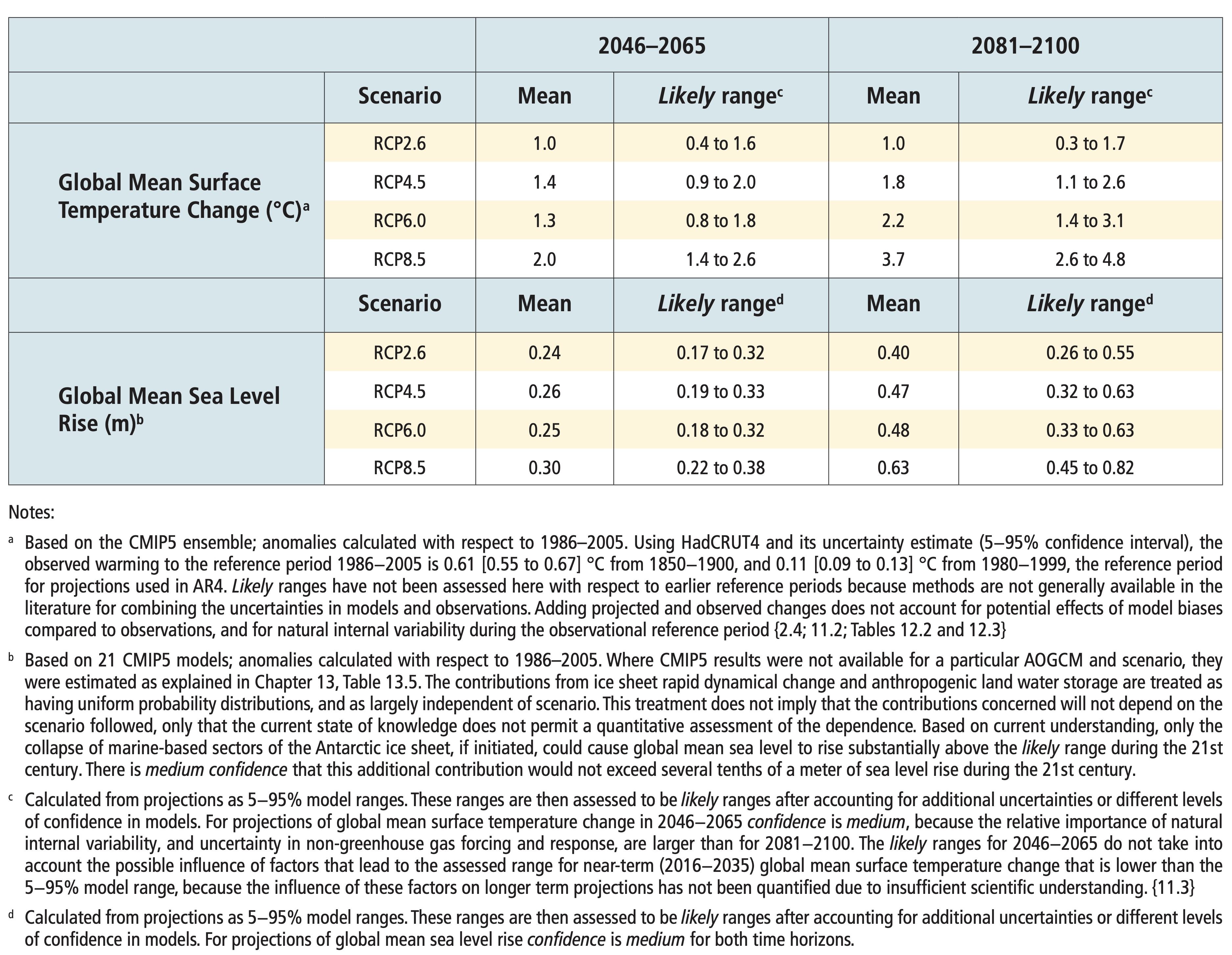
Projected change in global mean surface air temperature and sea level rise for mid and late 21st century relative to the reference period of 1986 – 2005. Reproduced from the Summary for Policymakers, Working Group 1, 5th IPCC Assessment.
RCP8.5
Representative concentration pathway 8.5 (RCP8.5) was a scenario in which the radiative forcing reaches 8.5 Wm-2 by 2100. It was developed to represent the worst case scenario. It is false to claim, as President Trump and others have done, that RCP8.5 has been the main driver for climate policy. Carbon Brief reports:
“Prof Detlef van Vuuren from Utrecht University, a leading figure in the development of emissions scenarios for many years, tells Carbon Brief that RCP8.5 is a ‘low-probability, high-risk scenario and it was always meant like that’…The scenario assumed a world without climate policy and was designed to explore the consequences of high levels of greenhouse gases and global warming. It was not, van Vuuren says, a “best-guess scenario” of what the future held in store.”
Debate about the usefulness of RCP8.5 was already taking place around the time of the publication of the fifth IPCC assessment report in 2014. Thus the retirement of RCP8.5 has not come out of nowhere, and it does not reflect a sudden change in understanding about how the climate functions. In particular, RCP8.5 is a scenario in which coal consumption continues to grow steadily throughout the 21st century. For the first two decades of the century, China’s growing economy, underpinned by manufacturing, was powered by coal, and with India developing fast, a substantial and sustained growth in coal consumption looked plausible as recently as 5 years ago – irrespective of arguments about the validity of RCP8.5. However, in the last 5 years, patterns of energy production have changed dramatically. As I have described elsewhere, China’s consumption of coal did not grow in 2025, for the first time in several decades, and India’s coal consumption fell. The world’s two most populous nations are in the middle of a technological revolution. It is true that coal consumption has increased in the United States, but even here, astonishingly, new electricity generating capacity is overwhelmingly based on renewables, because this is now cheaper than producing electricity from fossil fuels.
In the IPCC’s Sixth Assessment (published in stages over 2022-23), shared socio-economic pathways (SSPs) replaced RCPs. Like the RCPs, the SSPs were based around levels of radiative forcing. The “worst case” scenario was still based around a radiative forcing of 8.5 Wm-2 but a fifth scenario, SSP1-1.9 was added, representing an optimistic pathway based around achieving net zero emissions by 2050. In this scenario, based on strict controls of emissions to keep the radiative forcing down to 1.9 Wm-2, global temperatures were predicted not to exceed 1.5oC above the pre-industrial average (the aim of the Paris Agreement). It now seems highly unlikely that it will be possible to avoid exceeding 1.5oC of warming.
Our narrowing horizon
Work is now underway on the IPCC’s seventh assessment. This will utilise seven scenarios, but there will be no version of RCP8.5, the really high emissions scenario of the Fifth Assessment – which is what got President Trump so excited. However, far from signalling an end to talk of a climate crisis, the revised scenarios point to a darker, more problematic future, because along with the worst case scenario, it is clear that the most optimistic scenarios are no longer realistic either. Significant climate change is now “baked in”, even if the green revolution allows us to begin to think about reducing emissions. The range of likely outcomes has narrowed, but significant change to the global climate is now unavoidable.
The retirement of RCP8.5 reflects massive reductions in the cost of renewables technologies, the dramatic reductions in the cost of electricity generation from consumables achieved during the last decade, and the seismic shift created by China’s astonishing green revolution, now being replicated in India. However, carbon dioxide emissions are still growing; there is no sign yet of a decline in emissions, let alone an approach to net zero. Thus, while the original worst case scenario looks unrealistic, “the world’s most ambitious targets have also slipped out of reach” says Politico, quoting van Vuuren again: “I think overall we are simply in a situation that is bad news.”
Carbon Brief notes that “Over the past decade, global emissions have more closely tracked RCP4.5, one of the two “medium stabilisation scenarios” of the original four RCPs….The new “high” scenario projects warming in 2100 of closer to 3.3oC (with a range of 2.5oC to 4.4oC). This scenario would still come with catastrophic climate impacts, even if the level of warming would remain slightly below what was set out in RCP8.5.”
Already, despite a global mean temperature rise below 1.5oC, we see declining agricultural yields, floods in Asia and wildfires across Europe. As global temperatures rise still further, the future will present continuing and increasingly severe challenges as we seek to adapt to our ever-changing climate.


Leave a Reply