Recently, Nigel Farage and Liz Truss were speakers at a seminar in London organised by the Heartland Institute UK, whose Executive Director is Lois Perry, formerly the leader of the UK Independence Party. What are the aims of the Heartland Institute UK? The landing page for the Institute offers this statement:
“CSDDD: The European Union’s Corporate Sustainability Due Diligence Directive Is a Direct Threat to U.S. Sovereignty, Free Markets, and Individual Liberty
The radical environmental, social, and governance (ESG) movement has recently experienced substantial setbacks in the United States. However, ESG is far from dead. In fact, it will soon be imposed on America by the European Union…If left unchecked, the CSDDD will eviscerate U.S. sovereignty, free markets, and individual liberty, replacing those ideals with a new system of global corporatism designed and enforced by elites in Brussels.”
The CSDDD is a piece of European legislation designed to ensure that European companies cannot offshore their legal obligations by transferring manufacturing activities, for example, outside the EU; under this directive, it will be necessary to maintain the same environmental protections whether or not a company manufactures goods in the EU, as long as it wants to sell its good there.
“It is not hyperbolic to say the CSDDD is one of the most economically restrictive and nakedly authoritarian laws in the history of western democratic civilization” say the authors of the Heartland Institute (THI) policy statement on CSDD, before launching into a torrent of balderdash that can at best be described as hyperbolic.
But the main target of the THI is not EU policy as such. Its core mission is to fight against the idea that consideration of the impact of human behaviour on the environment should in any sense restrict the activities of private enterprise. In particular, their target is “climate alarmism” and the science that supports concern about the impact of fossil fuels on the planet, and their main weapon is not rational argument supported by evidence but misinformation.
Ideology
THI began as a sock puppet for the tobacco industry, funded by Philip Morris to undermine efforts to regulate smoking in public. Central to this was the attempt to prove that there was no scientific evidence that second-hand smoke was harmful. THI and Philip Morris lost that battle, because there was an abundance of solid peer-reviewed evidence to corroborate the hypothesis, and because policy-makers followed the evidence. Fundamentally, the raison d’être of THI was and is idealogical: its mission is to support the primacy of individual choice, whatever the consequences for others. If I smoke, it is my choice and my right to do so, and it’s not my problem if that choice gives somebody else lung cancer.
Modus Operandi
THI has mounted a campaign of pseudo-scientific challenges to peer-reviewed science with the aim of undermining public acceptance of the hypothesis that the earth is warming and that this warming could lead to catastrophic consequences. To a professional scientist, THI’s cosplay science appears risible, but professional scientists are not its target audience. Rather, THI’s messages are directed at ordinary people who find the thought of climate breakdown alarming. Its method is simple: to encourage doubt about the existence of a scientific consensus on climate change and in so doing to attempt to foster a groundswell of public opinion that will resist policy changes designed to address the problem. Thus THI promotes the idea that scientific opinion is divided, and that the data are open to widely varying interpretations.
THI has developed a sophisticated machinery to promulgate these misrepresentations of scientific consensus. It has hired staff who it calls “fellows” to do its work, mimicking the pattern of research institutes. To lend credibility to their misinformation, THI “fellows” cite peer-reviewed scientific literature. However, the meaning of the cited literature is deliberately distorted so that the argument in the original work bears little or no relation to THI’s summary of it. To a professional scientist, the deceit is obvious; to a superficial reader, or somebody inexperienced in reading scientific literature, the impression is created of debate and controversy even when none exists.
Sowing Confusion
THI peppers its misinformation liberally with citations to scientific literature to add an aura of scholarship and to falsely convey the impression that its contrarian claims reflect a scientific consensus. At the same time, it also seeks to create the false impression that the results of scientific research into climate change are ambiguous and doubtful. As an illustration, consider the following false claim by THI on a page entitled “Climate Model Fallibility” on its Climate at a Glance web site:
Model errors have become openly acknowledged over the past few years in peer reviewed studies which have concluded climate models “are too hot” and produce “implausibly hot forecasts of future warming.” This fact is confirmed when actual temperature measurements from surface stations, weather balloons, and global satellites are compared to the warming projected by 102 climate models.
This statement is supported by a citation to an article in the prestigious journal Science. Reading it, you could be forgiven for thinking that climate modelling was the scientific wild west. However, careful examination of the cited source – a news article written by a staff journalist working for Science – reveals a very different picture. Because of its journalistic style, the news article is not written in the careful, measured language typical of a scientific paper; some of the turns of phrase are more colourful and, moreover, it is summarising the views of a number of researchers, rather than a specific piece of peer-reviewed research. The article says the following:
“In the past, most models projected a “climate sensitivity”—the warming expected when atmospheric carbon dioxide (CO2) is doubled over preindustrial times—of between 2°C and 4.5°C. Last year, a landmark paper that largely eschewed models and instead used documented factors including ongoing warming trends calculated a likely climate sensitivity of between 2.6°C and 3.9°C. But many of the new models from leading centers showed warming of more than 5°C—uncomfortably outside these bounds.”
Of course this is a difference, but one of scale not of direction of travel. The author notes that when researchers compared predictions of some of the climate models with paleoclimate data, they found that the models were predicting too fast a rate of warming. Subsequent work also illuminated irregularities in the way that models represented the role of ice crystals in cloud formations in regulating heat flows. However, the article points out that
“Many of the hot models otherwise simulate the climate extremely well overall, doing a better job than their predecessors at capturing atmospheric connections between remote ocean basins and the distribution of rainfall”
None of this discussion indicates that these complex models have failed; rather, what it reveals is a sophisticated and self-critical process designed to produce more sophisticated and reliable predictions. Any process that revolves around complex models will – if it is working properly – involve incremental adjustments and improvements. And because of such concerns, researchers working on the 2021 Intergovernmental Panel on Climate Change (IPCC) report, tempered their predictions using experimental data. This is not failure but science at work.
But is this a good news story about warming? Does it suggest we should all relax a little about climate change? The author of the article in Science continues:
“For 2100, in a worst-case scenario, that would reduce a raw 5°C of projected warming over preindustrial levels to 4.2°C. It’s good news for the modelers—but also a clear, and dismaying, sign that global warming has gone on long enough to help chart its own path.”
A global temperature increase of 4.2°C above pre-industrial levels would be truly catastrophic; such information offers no comfort at all to those who will be living at the end of this century.
THI has extracted from the article the idea that climate models are continuously being incrementally improved (i.e. the accuracy of highly complex but already accurate models is being continually improved via a process of conjecture and refutation) and translated that rather casually into “Model errors have become openly acknowledged over the past few years in peer reviewed studies…This fact is confirmed when actual temperature measurements…are compared to the warming projected by 102 climate models“. This is a massive distortion of the argument of the source that is used to supposedly legitimate THI’s statement. Indeed, the Science article reaffirms that “many of the hot models otherwise simulate the climate extremely well overall” and suggests a revised climate sensitivity that remains highly alarming.
Easy Work
The modus operandi is to cite an article in a scientific journal not necessarily accessible to the general public, pick out a few sentences from the abstract or the body of the article and string together a story which paints a picture that is typically very different from that communicated in the article itself. THI’s “explainers” and news items are not peer-reviewed; they are subject to no rigorous scrutiny, thus they are quick to write but it takes quite a lot of time to respond to them – a well-funded misinformation machine like THI can spew out false reports at such a rate that it is hard for busy, hard-working scientists to respond to all (or even some) of the content they produce. With the aid of an extensive political and industrial apparatus committed to supporting fossil fuel interests, this misinformation is rapidly and widely disseminated. To the general public, understanding the difference between such misinformation and rigorous peer-reviewed science can be challenging.
NIPCC
The IPCC has been a global focus for understanding of the effects of human activity on the climate. For several decades the world’s leading climate scientists have collaborated under the auspices of the IPCC to model our changing climate and to inform policy decisions by governments. THI established its own “Nongovernmental International Panel on Climate Change”, NIPCC, to attempt to undermine public understanding of the methodology and conclusions of the IPCC.
This effort was led by physicist Fred Singer. To contextualise Singer’s significance in contemporary climate science, it should be pointed out that when I arrived in Manchester to start my BSc in 1984, he was already the age that I am now (60). By the time of NIPCC II in 2014, Singer was 90. If you think that’s remarkable, the THI NIPCC web page says:
“One of the world’s most distinguished atmospheric scientists, he travels the world meeting with scientists, discussing NIPCC’s research, and recruiting new members to the group.”
Singer died in 2020, so that’s quite a statement. THI claims that
“In November, 2015, the three lead NIPCC authors – Craig Idso, Robert M. Carter, and S. Fred Singer – wrote a small book titled Why Scientists Disagree About Global Warming: The NIPCC Report on Scientific Consensus revealing how no survey or study shows a “consensus” on the most important scientific issues in the climate change debate, and how most scientists do not support the alarmist claims of the Intergovernmental Panel on Climate Change.”
In view of this claim, it is striking that scientists are not better represented among the lead authors of NIPCC II, which included, in addition to Idso, Carter and Singer, an economist, a British political advisor cum journalist, a management consultant, an emergency physician, a lobbyist and a manager at THI. Senior scientists employed at the world’s leading universities and research institutes are notable by their complete absence.
Singer made a variety of bold claims before his death, including stating that there was no evidence that climate change was occurring. The DeSmog blog quotes him saying in 2016:
“The Intergovernmental Panel on Climate Change (IPCC) has to provide proof for significant human-caused climate change; yet their climate models have never been validated and are rapidly diverging from actual observations. The real threat to humanity comes not from any (trivial) greenhouse warming but from cooling periods creating food shortages and famines.”
The evidence is very clearly to the contrary, but now Singer has slipped off this mortal coil, leaving others to deal with the problems that he assured them so emphatically were not real. The figure below (also reproduced in a different post) shows global mean temperature data from a number of different sources. Up to about the turn of the century, the increase in global temperature was comparatively small relative to the size of the scatter in the data. Since the turn of the century, the rate of increase in global mean temperature has increased, and the size of the increase in global mean temperature relative to the scatter in the data is now quite large. Moreover, the closeness of the agreement between the six different sources is striking.
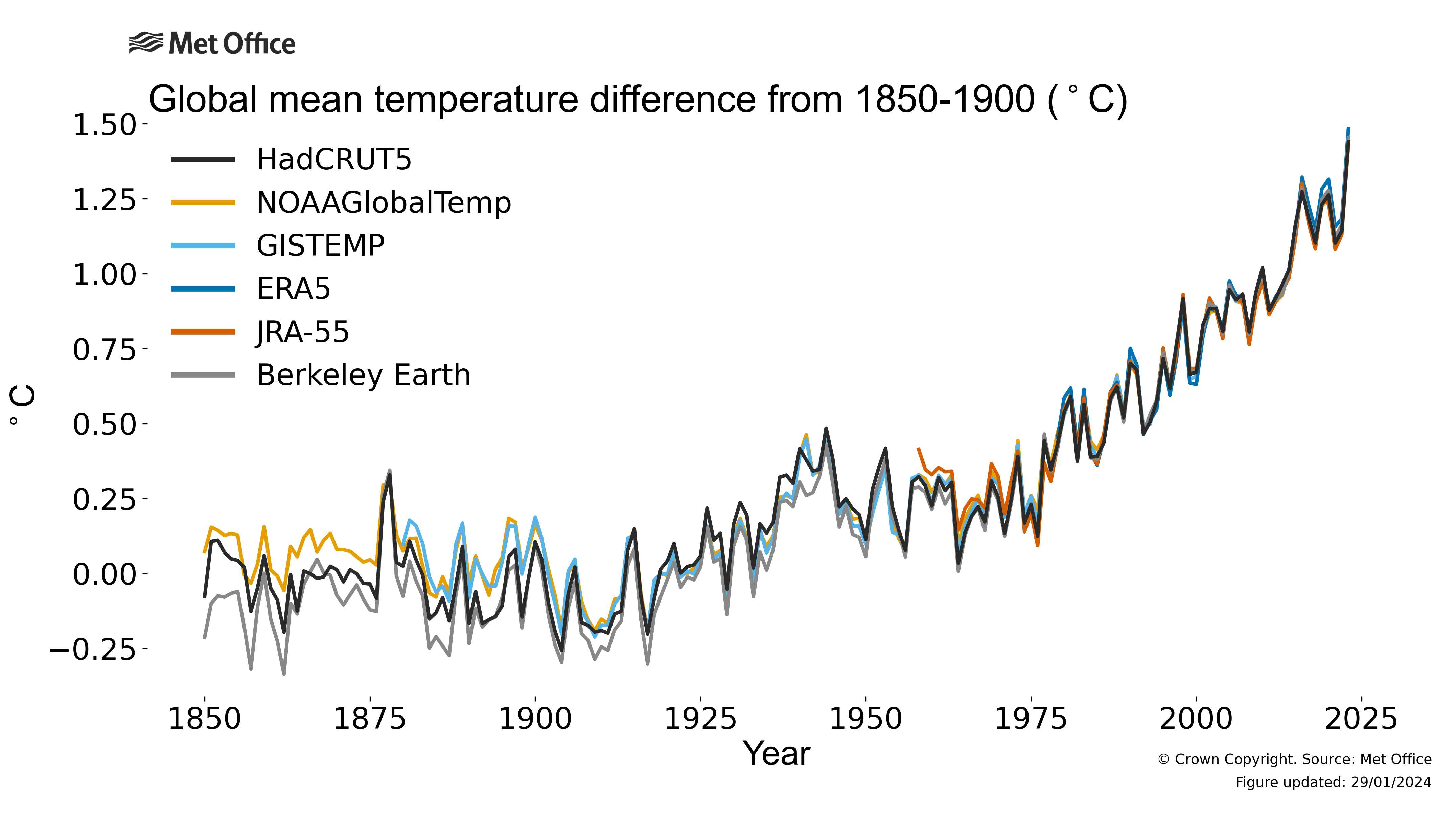
Figure 1. Annual global average temperatures expressed as the difference from pre-industrial conditions based on the 1850-1900 average. Four different data sets are shown – HadCRUT5*, NOAAGlobalTemp*, GISTEMP, and Berkeley Earth* – as well as two reanalyses – ERA5 and JRA-3Q. There is good agreement on the overall evolution of global temperatures and year-to-year variability. From the Met Office Climate Dashboard.
International Conference on Climate Change
In a few days’ time, THI is organising the 16th International Conference on Climate Change (ICCC), a meeting that it describes as
“a unique platform for rigorous, science-based discussion of climate science, energy policy, and real-world economic impacts…the ICCC brings together leading scientists, energy experts, policymakers, and thought leaders to examine the data and challenge prevailing assumptions about climate science and policy.”
None of the 12 keynote speakers is a working scientist. Two (John Clauser and William Happer) are retired, octagenarian scientists, but neither has spent their career working on climate science. Clauser won the Nobel Prize for Physics for work on quantum theory but has published just 10 papers since the turn of the century, all of them on Bell’s theorem, the topic for which he was awarded the Nobel Prize, and none of them on the subject of climate science. Popperian critical rationalism is not focussed on personalities, but on the formulation of testable hypotheses. Science is not synonymous with the pronouncements of scientists; rather, it is a mechanism – a process of conjecture and refutation. The pronouncements of a contrarian octagenarian scientist, however important their achievements in a different field, have no meaning in the context of climate science unless they are also able to formulate new testable hypotheses and to engage with the process of conjecture and refutation that constitutes the scientific method.
ICCC16 will make awards to luminaries. These include Anthony Watts, who failed to graduate from a degree programme in Electrical Engineering and Meterology at Purdue University, and who is the founder and editor of the blog Watts Up With That (WUWT), a key contributor to THI’s Climate Realism page and somebody with a long track record of systematic and determined misinformation (he will be receiving the “Climate Pioneer” award). Also giving a keynote lecture at ICCC16, and chairing a session on “Climate Science: An International Perspective”, will be anthropology graduate Lois Perry, which takes us back to the core of THI’s mission. Its board contains no professional scientists; its mission is political and ideological. It does not seek to do science, but to create a fog of confusion around science in order to serve its political aims.
Conclusions
Climate science relies on very complicated models that are tested over many years against data that are acquired through massive international collaborative programmes of work. If our understanding of the climate and its evolution over time is to be scientific, then it must be grounded in the Popperian process of conjecture and refutation: mutual control through rational criticism, based on deductive reasoning from a hypothesis to an experimental test. A scientific model for the climate should contain within it, in Popper’s words, “the seeds of its own destruction”: it should be possible to define clearly under what conditions the model would be considered to be falsified.
The problem with the critique of climate science offered by THI is not that it seeks to falsify hypotheses about climate change (falsification is central to how science works), but that its aim is to spread confusion and misinformation about climate science and the predictions of climate models; and that it misrepresents the results of experimental tests for those models. This is not the objective scientific process of conjecture and refutation, but rather a subjective, non-scientific approach that is ideologically motivated.


Leave a Reply